
DIN Rail Machine
A Rotary Punch machine that punches coil sheet without stopping it, used in the punching stage of a DIN rail production line.
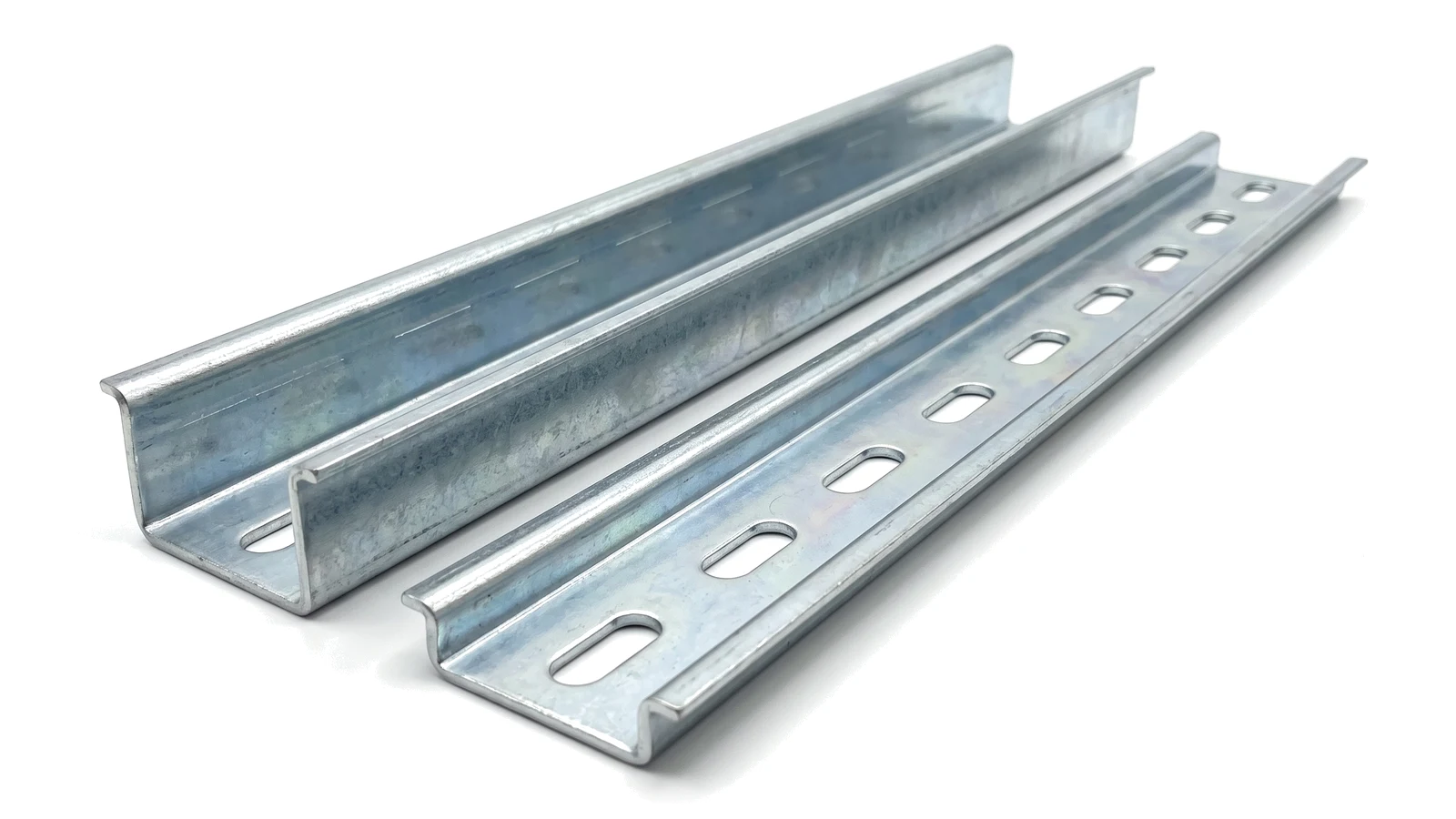
Perforated DIN Rail Strip
The punched flat strip before the DIN rail is formed: 45–60 mm wide, 1–1.5 mm thick, 2 m long.
Applications & Industries
- Mounting rails for circuit breakers and terminals in electrical panels
- Serial punching (perforation) stage in DIN rail production lines
- Rail production in different widths and thicknesses
- Mounting rails for fuses, relays and building automation
Engineering & Manufacturing Technology Analysis
Key features of the solution developed by the YILSA R&D team
01.DIN Rail Punching with Rotary Punch
The machine punches the sheet without stopping it, using male and female dies on two adjacent rotating drums. It is designed for the serial punching (perforation) stage of a DIN rail production line and can work with rails of different widths and thicknesses.
02.Two Punching Stations in Series
Because the holes in a DIN rail are very close together, the same frame carries two punching stations in series. Stripper guides that follow the sheet through both stations hold it steady vertically and prevent unwanted bending.
03.Easy Die Change
The punches are fixed to the drums from the side with set screws; loosening the screws lets you remove the dies easily and fit sharpened or new ones.
The dies are made of 1.2379 (D2) Böhler tool steel at 60 HRC hardness and have a 6 mm regrinding allowance; after sharpening, shims are added underneath so the dies can be reused.
Technical Specifications
Key features of the product and the machine
Product
- Strip Width
- 45 – 60 mm (unformed)
- Length
- 2 m
- Sheet Thickness
- 1 – 1.5 mm
- Material
- St37 pre-galvanised or black sheet
Machine
- Punching Technology
- Rotary Punch
- Punching Speed
- Up to 24 m/min
- Punching Stations
- 2, in series
- Die Steel
- 1.2379 (D2), 60 HRC
Planning a DIN Rail Machine?
At YILSA we can design and build a DIN rail line on a turnkey basis to suit your company's specific size, speed and capacity requirements. Send us your technical drawing and requirements to get an engineering quote.